How a Trading Card Gets Made
It fits in your shirt pocket, but a trading card is a tiny factory product — printed a hundred at a time on room-sized machines, wrapped in shine, glued around a secret dark middle, then shuffled into packs by machines that deal like card sharks. Here's the whole trip, from first sketch to your hands.
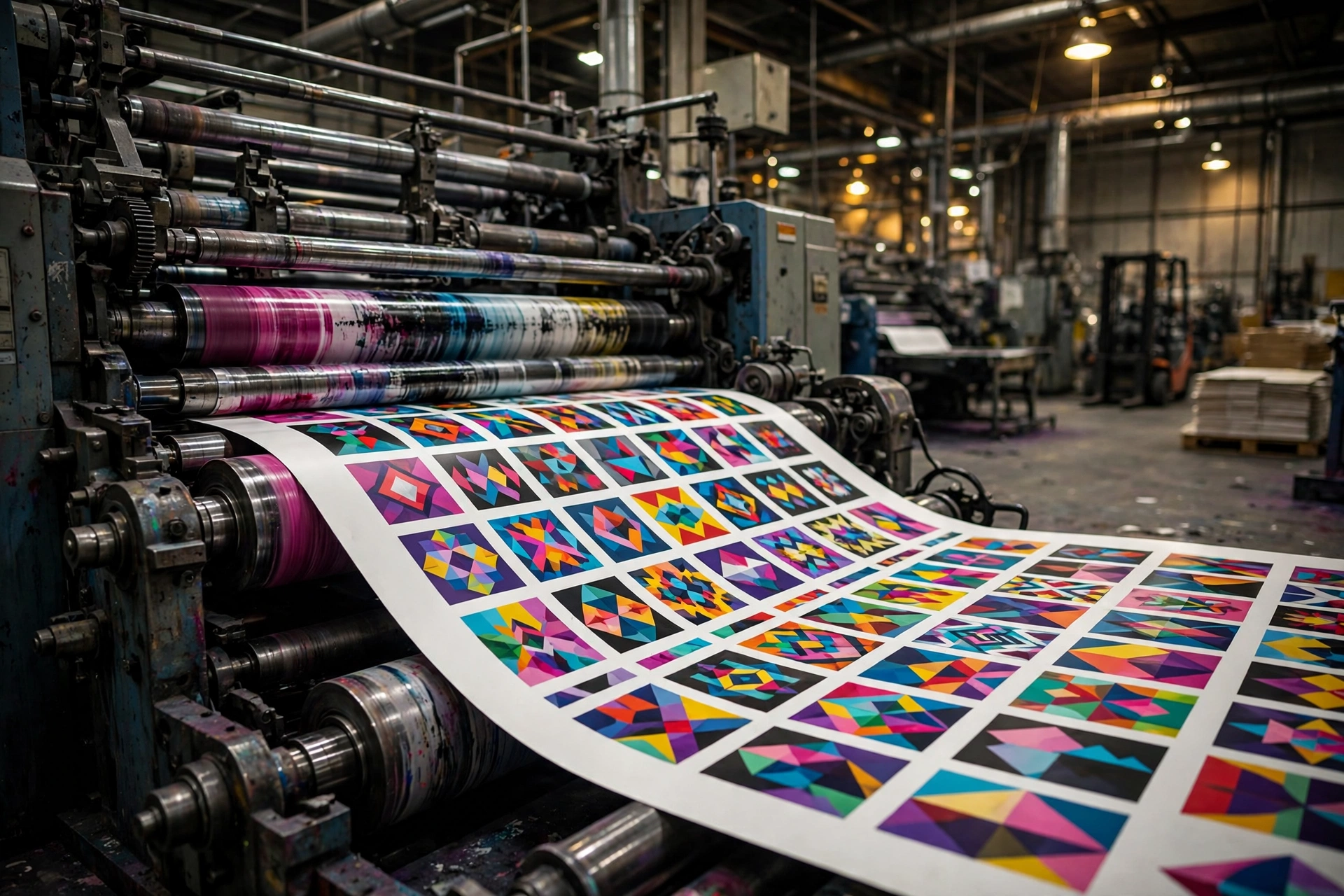
Illustration — an offset press at work. Cards aren't printed one by one — they ride through the factory on big sheets like this one.
✦ The Journey at a Glance
✦ Anatomy of a Card: The Layer Cake
Slice a shiny card in half and zoom way in. It's not one piece of paper — it's a sandwich. Here's the stack, top to bottom, on a foil card:
▶ How It Works: The Factory Trip
-
It starts on a screen
An artist draws the character or player, and a designer builds the card around them — name, numbers, borders, the works. Then the prepress crew splits that artwork into separate layers: one for each ink color, plus extra layers that say where the shine and the words go.
-
Every color gets its own metal plate
The press is the size of a room and hungry — a big one can print up to 15,000 sheets an hour. Each ink color rides on its own thin metal plate, wrapped around a spinning cylinder. Four plates, four inks: cyan, magenta, yellow, black.
-
The ink takes a detour
Here's the trick that names the machine: the plate never touches the paper. Ink rolls from the plate onto a soft rubber blanket, and the blanket presses the picture onto the sheet. That rubber middleman is why it's called offset printing. Usually the card backs go through first, then the sheet comes back for its fronts.
-
The shine gets built in
Shiny cards start with foil film that arrives on huge rolls. The rainbow pattern was embossed into the film from a nickel master stamp, in grooves finer than a human hair is wide. The foil is laminated to the card stock, and the artwork prints on top of it — with white ink painted underneath wherever the shine should stay hidden.
-
Every sheet gets a raincoat
Before the sheets move on, they get a clear coat of varnish — glossy or matte, with UV-cured gloss on some fancy finishes. The coat guards the ink against scratches and gives the finished card its smooth glide when you shuffle.
-
One sheet, a whole crowd
Nobody prints cards one at a time. A single sheet holds 100, 110 or 121 cards in a grid — and commons get their own sheets, uncommons get theirs, and the rare and shiny cards get sheets of their own. Rarity is born right here, at the printer.
-
The big cut
Cutters slice the sheet into strips, then into single cards with sharp, pointy corners. Then a die punches off those points in a separate step — that's where the famous rounded corners come from. Inspectors pull sheets that printed crooked, smeared, or off-color before they ever become cards.
-
The great shuffle
Stacks of cut cards feed into collating machines, which deal them into packs following a planned recipe — so many commons, so many uncommons, and a rare one landing right on schedule across the whole print run. The machine seals each pack in foil or paper wrap, and the packs march off into boxes. All that's left is the best part: somebody rips one open.
★ Did You Know?
There's a dark stripe hidden inside every good card
Tear a worn-out card in half and look at the edge: there's a dark layer in the middle. That core is dyed blue or black on purpose — it blocks light, so nobody can hold a card up to a lamp and peek at what's hiding on the other side.
Rounded corners are a two-step job
Cards aren't born round-cornered. They're first cut into rectangles with sharp, pointy corners, and then a die clips the points off in a whole separate step. One sloppy clip is all it takes to ding a corner — and a grade.
A sheet is a small crowd
Cards are printed on giant sheets holding 100, 110 or 121 cards at once — and commons, uncommons, rares and shiny cards each get their own sheets. So when you pull a rare card, its rarity started at the printing press, not in the pack.
The rainbow is carved, not painted
The shimmer on a foil card comes from microscopic grooves stamped into a metal film from a nickel master plate. The grooves split plain white light into colors — which is why the rainbow crawls across the card when you tilt it.
Bright tape means "stop the line"
Foil arrives on huge rolls. When one roll runs out, a new one is spliced on with a strip of bright-colored tape. Any sheet carrying that tape is supposed to be thrown out during quality checks — but once in a while one sneaks through and becomes a strange, collectible error card.
"Offset" means the plate never touches the paper
On an offset press, the ink hops plate → rubber blanket → sheet. The picture lands on the rubber as a mirror image, then flips back to normal on the sheet. The soft rubber middleman prints a sharper picture and keeps the metal plates from wearing out.
✎ Game Cards vs. Sports Cards
Same factory dance, a few different steps. Pokémon and Magic cards print each rarity on its own sheet, and their shine is built into the stock before the artwork lands. Sports cards often get foil stamped on as an extra step — and their packs hide bonus cargo like autographs and tiny pieces of game-worn jerseys, slipped in at pack-out under guard. Either way, the pack you're holding was planned like a recipe long before it met you.
✎ For Teachers & Curious Minds
Talk it over:
- Why is the middle layer of a card dark? What would go wrong in a card game if it wasn't there?
- Cards are printed 100 at a time on one sheet, all in neat rows — so where does the "random" in a pack come from? Who plans it?
- Which step in the journey would be hardest to do by hand? What do the machines do better — and what can they still get wrong?
We The Humans · Learning Line — free to share with credit. Printing recipes vary a little from maker to maker, and we've said so where it matters.
Quick answers
Why is there a dark layer inside a trading card? It's the core — the paper layers are bonded around an opaque middle dyed blue or black. It blocks light, so nobody can hold a card up to a lamp and peek at what's hiding on the other side, and it gives the card its snap.
How many cards are printed on one sheet? Usually 100, 110 or 121 at once — and commons, uncommons, rares and shiny cards each get their own sheets. A card's rarity starts at the printing press, not in the pack.
If cards are printed in neat rows, where does a pack's randomness come from? From the collating machines at pack-out. They deal the cut cards into packs following a planned recipe — so many commons, so many uncommons, and a rare one landing right on schedule across the whole print run.